



Module 1:
WHAT IS COMMERCIAL TOBACCO?
Before we cover the different types of tobacco products, let’s first look at the difference between traditional tobacco and commercial tobacco.
Traditional tobacco is defined as tobacco that has been grown or harvested for spiritual and medical uses. Many American Indian and Alaska Native communities use traditional tobacco as a part of their culture when practicing religion and providing medical treatment.
Commercial tobacco is very different. This type of tobacco is made and sold by large companies with the intention of making a lot of money. Tobacco companies combine tobacco plants with thousands of added chemicals to produce products like cigarettes, cigars, smokeless tobacco, nicotine pouches, and vapes.
In this training, when you learn about the dangers of tobacco, you are learning about the health effects of commercial tobacco products, not traditional tobacco.
This module will cover:
● Combustible tobacco products
● Smokeless tobacco products
● Electronic tobacco products
COMBUSTIBLE TOBACCO PRODUCTS
Combustible products are tobacco products that are burned. This includes cigarettes, cigars, cigarillos, and hookah. When these products are burned, the heat causes tobacco and oxygen in the air to break down, which the user inhales.
Cigarettes
Cigars &
Cigarillos
Hookah
Cigarettes
A cigarette is a small roll of tobacco wrapped in thin paper. The tobacco inside is made from dried and processed tobacco leaves. When someone uses a cigarette they light one end and inhale the smoke through the other end, which usually has a filter.
Some people think filters make cigarettes safer, but that’s not true. Filters were designed to make people believe that harmful chemicals would be filtered out before they reached the lungs, but the dangerous chemicals are still there.
When a cigarette burns, it creates over 7,000 harmful chemicals. At least 69 of these chemicals are known to cause cancer!
The following are just a few of the chemicals found inside a cigarette:
● Acetone - found in nail polish
● Ammonia - common household cleaner
● Butane - used in lighter fluid
● Lead - used in batteries
Cigars & Cigarillos
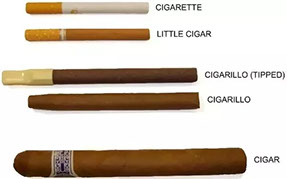
A cigar is a roll of aged tobacco leaves wrapped in a tobacco leaf or a material that contains tobacco, instead of paper. Cigars are thicker than cigarettes and contain more tobacco.
A cigarillo or “little cigar” is a shorter and skinnier version of a cigar, but larger than cigarettes. Like cigars, cigarillos are made by wrapping tobacco in a tobacco leaf. Many cigarillos come in sweet flavors, sold in bright packaging, and are very cheap. This can make them seem fun, but they are just as dangerous as cigarettes. In fact, about 9,000 people die every year from smoking cigars and cigarillos.
Hookah
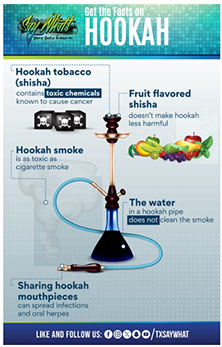
A hookah is a water pipe used to smoke flavored tobacco called shisha. People may also call it a “shisha pipe” or “water pipe.”
The bowl is filled with tobacco, which is heated using charcoal to create smoke. The smoke travels through the stem and into the base, which contains water that cools the smoke before it is inhaled through the mouthpiece.
Some people think hookah is safer than smoking cigarettes, because they think the water filters out the toxins, but this is not true. Hookah smoke is just as toxic as cigarette smoke. In fact, one hookah session is equal to smoking 100 cigarettes! Hookah has 1.7x more nicotine, 36x more tar, and 9x more carbon monoxide than cigarettes.
SMOKELESS TOBACCO PRODUCTS
As the name suggests, smokeless tobacco refers to tobacco products that are not burned or heated and do not create smoke. They are non-combustible. Instead, these tobacco products are placed in the mouth between a person’s cheek and gum.
Just like combustible tobacco, these products are also dangerous. Smokeless tobacco contains over 4,000 different chemicals with at least 30 of them known to cause cancer! There is no safe form of smokeless tobacco.
The smokeless products we will learn about are:
● Chewing tobacco
● Snus
● Nicotine pouches
Chewing
Tobacco
Snus
Nicotine
Pouches
Chewing Tobacco
Chewing tobacco is a smokeless product made from cured, shredded tobacco leaves. It can come in different forms, but the most used is loose leaf, which is shredded tobacco leaves.
It’s often packaged in round cans and called “dip” or “chew,” and just one tin of chewing tobacco can contain as much nicotine as 4 cigarettes.
Snus
Snus is another commonly used form of smokeless tobacco. It is made of finely ground tobacco powder that is wrapped inside a pouch. Like chewing tobacco, nicotine is absorbed through the gums and into the body. One can of snus can contain as much nicotine as 60 cigarettes.
Nicotine Pouches
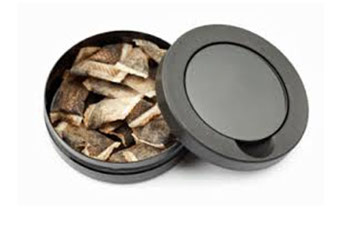
Nicotine pouches look similar to snus, but they do not contain tobacco leaves. Instead, they contain synthetic nicotine. This means that the nicotine in these pouches come from a laboratory. They are often flavored and can contain high levels of nicotine.
Like other smokeless products, they are placed between the lip and gum, where nicotine is absorbed into the body. Unlike chewing tobacco, the contents of the pouches dissolve over time, and the pouch itself is removed after use.
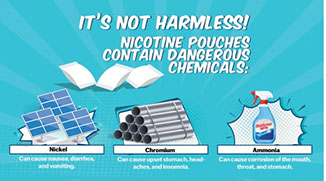
Even though nicotine pouches do not contain tobacco leaf, they are still dangerous. Some people believe they are harmless because they are small and smoke-free, but this is not true.

ELECTRONIC TOBACCO PRODUCTS
Electronic cigarettes, also known as vapes, are battery-powered devices. They do not burn tobacco leaves like cigarettes, but they still deliver nicotine and other harmful chemicals to the body.
These products contain a liquid called “e-liquid” or “vape juice.” When the device is used, the battery heats a small metal coil. This heat turns the e-liquid into mist called an aerosol, that is inhaled into the lungs.
Many people think the cloud from a vape is just water vapor, but that is not true. The aerosol can contain nicotine, metals, tiny particles, and other harmful flavorings.
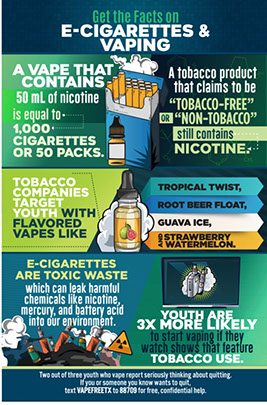
Vapes are often designed to appeal to young people, and they may have:
● Bright colors
● Sweet or fruity flavors like cotton candy,
mango, or mint
● Sleek, high-tech designs
These features can make vaping seem fun, harmless, or “no big deal,” especially to young people, but the chemicals in e-liquid and aerosol are dangerous
Watch the video below to learn more about how vapes work and some of the dangerous chemicals they contain.
WHAT DO ALL THESE PRODUCTS HAVE IN COMMON?
Even though each tobacco product is made and packaged differently, they all have some important things in common.
They contain high levels of toxic chemicals, including:
● Nicotine- A very addictive chemical that
comes from the tobacco plant or is made
in a lab. It makes it hard to quit once
someone starts using it.
● Carcinogens- Cancer-causing chemicals
such as benzene, acetaldehyde, and
formaldehyde. These can cause damage
to cells in the body and lead to tumors.
● Heavy metals- Toxic metals like nickel
and lead that can harm the lungs and
heart.
No matter the form, cigarettes, cigars, hookah, chewing tobacco, nicotine pouches or vapes; commercial tobacco products can cause serious harm to the body and can lead to addiction.
In the next module, we will take a closer look at how these products affect the health of those who use them and why avoiding them is one of the best choices you can make for your health.
Sources for module 1 include: Truth Initiative, Centers for Disease Control and Prevention, and Say What!


Say What! EST. 2011
Home | About | Resources | Events | Speak Up | Login

|

|

|

|

Phone
512.245.8082
Mailing Address
Texas School Safety Center
ATTN: Say What Program
Texas State University
601 University Drive
San Marcos, TX 78666


Say What! was created and designed by young people from across Texas and connects students interested in eliminating tobacco from their schools and communities. The Say What! movement is funded by the Texas Department of State Health Services through a contract with the Texas School Safety Center at Texas State University.